-
Simple Book Press
-
 Flowers can be left between the pages of a heavy book. While this distributes enough weight and can hold many blooms, it is not the ideal way to preserve flowers. Older flowers can fall out of the pages as you open the book to add new ones. If you do not line the pages with additional paper, the blossoms could stick to the pages, leaving behind stains and even tearing the flowers as you take them out.
If you choose to press flowers in a book, do so only as a temporary method. Place the flowers between pages and mark those pages with a slip of paper. Do not press down to flatten the blossoms, as this will encourage sticking, but simply close the book over the blooms. Transfer within a few days to a more sturdy press.
Cardboard Press
-
A simple press can be made using cardboard, lining paper and rubber bands.
Good material for lining paper includes parchment paper or waxed paper, as the flowers are less likely to stick to the surface of the pages. Plain paper or brown butcher paper can be used, but the blossoms are more likely to stick. Newspaper is not advisable, as the ink could come off and discolor the blooms.
To form a cardboard press, place the flowers between squares of lining paper and sandwich the lining paper between squares of cardboard. You can repeat this layering as many times as necessary for as many flowers as you need to press. Always place the flowers between the lining paper, to prevent sticking, and the lining paper between cardboard, to add structure and weight. Secure the press with large rubber bands, arranging the bands evenly across the cardboard for even weight distribution.
-
Plywood Press
-
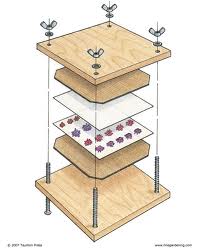 A plywood press uses the same structure of layering lining papers and cardboard, but adds an outer plywood shell. The top and bottom squares of plywood need holes drilled into all four corners to place bolts or screws. Wing nuts hold the bolts in place. The finished press looks like a miniature table, with a plywood top and bottom and bolts as legs.
This plywood press requires more effort than the cardboard press, but its construction produces more even weight distribution and a sturdier press.
-
Category: Art
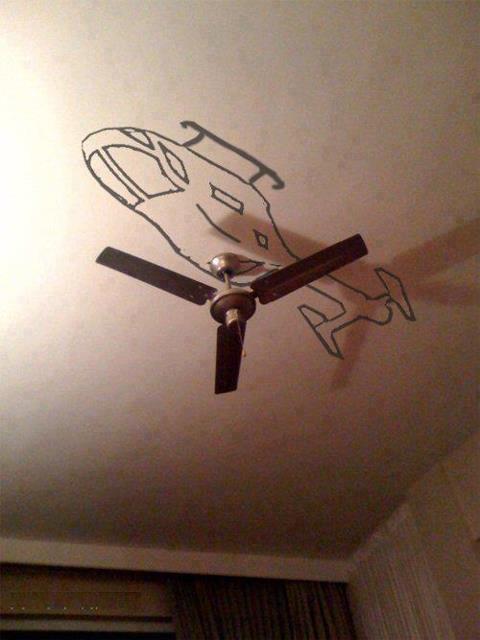
Ceiling Fan Helicopter
This is cute and creative – If you want to recreate it, find the shape you want and transfer it to the ceiling (here’s one way of transfering an image). Paint with acrylic paints.
via bitsand pieces – my 2nd favorite blog!
Natural Dyed Eggs
Check out the complete instructions at bigsislilsis.
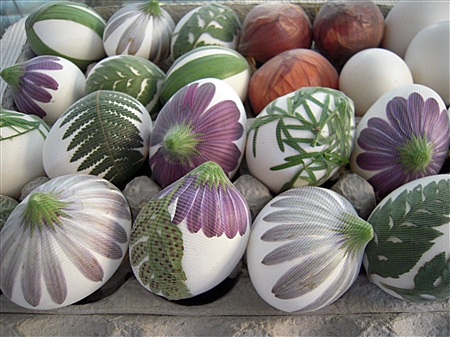
Here are the eggs ready to be dyed.

Here’s the finished product. Lovely!
Marbled Nails
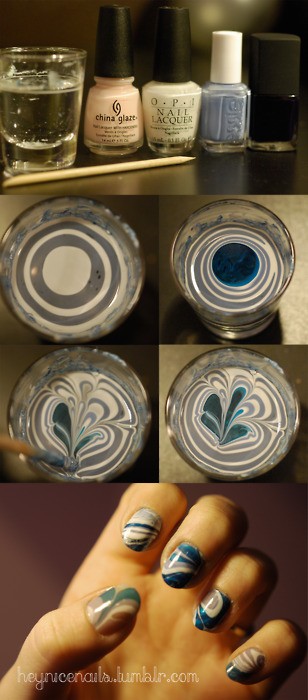 Supplies: orange stick or toothpick, shot glass or cup (the smaller the circumference, the less polish you end up wasting), room temp. water, nail polish, tape (optional, but it helps with the clean up)
I like to begin by prepping my nails with base coat and one coat of polish. Here I used China Glaze Innocence for a nice neutral base.
Steps:
1. Fill your cup with some warm or room temperature water. If the water is too cold, the nail polish will seize up.
2. Choose the polishes you want to work with; keep in mind the opacity of the polish you are using, if its too sheer, it might not look right.
3. I like to begin with the lightest color. Load up the brush and let a big drop of polish fall into the water. Continue with the other colors until you have a few concentric circles of polish in the water.
4. Using the toothpick or orange stick, drag through the polish from the edge toward the middle. Continue to drag the stick through the polish until you find a design that you think looks pretty.
5. Optional: tape around the edge of the nail to protect your finger from becoming covered with nail polish. Scotch tape works perfectly for this.
6. Holding your finger horizontally, dip your fingernail into the glass, making sure it is completely submerged.
7. Use the toothpick/orange stick to trace around your finger, gathering up all the unused nail polish in the glass.
8. Lift your finger out of the glass, and let dry before taking the tape off.
9. Continue with your other nails until you have a full set of beautifully water marbled nails.
10. Slick on your favorite top coat and Voila! All done!
Most importantly, have fun! As with any type of nail art, practice makes perfect, so don’t get discouraged if you don’t get it right the first time
Hide Your Alarm
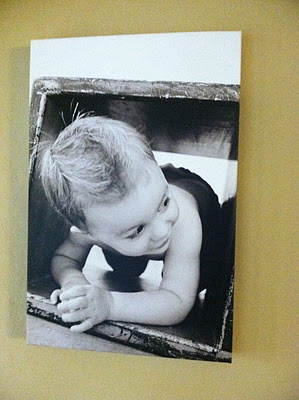
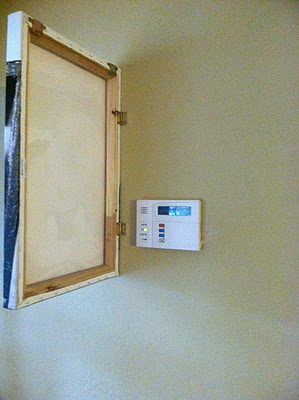
Use flat hinges on the side of a canvas piece of art to hide those unsightly necessities! Great idea via thethirdboob
 Do It And How