This was too funny to not repost. via
by Bud Herron
Some people say cats never have to be bathed. They say cats lick themselves clean. They say cats have a special enzyme of some sort in their saliva that works like new, improved Wisk – dislodging the dirt where it hides and whisking it away. I’ve spent most of my life believing this folklore. Like most blind believers, I’ve been able to discount all the facts to the contrary – the kitty odors that lurk in the corners of the garage and dirt smudges that cling to the throw rug by the fireplace.
The time comes, however, when a man must face reality; when he must look squarely in the face of massive public sentiment to the contrary and announce: “This cat smells like a port-a-potty on a hot day in Juarez.” When that day arrives at your house, as it has in mine, I have some advice you might consider as you place your feline friend under your arm and head for the bathtub:
— Know that although the cat has the advantage of quickness and lack of concern for human life, you have the advantage of strength. Capitalize on that advantage by selecting the battlefield. Don’t try to bathe him in an open area where he can force you to chase him. Pick a very small bathroom. If your bathroom is more than four feet square, I recommend that you get in the tub with the cat and close the sliding-glass doors as if you were about to take a shower. (A simple shower curtain will not do. A berserk cat can shred a three-ply rubber shower curtain quicker than a politician can shift positions.)
— Know that a cat has claws and will not hesitate to remove all the skin from your body. Your advantage here is that you are smart and know how to dress to protect yourself. I recommend canvas overalls tucked into high-top construction boots, a pair of steel-mesh gloves, an army helmet, a hockey face mask and a long-sleeve flak jacket.
— Prepare everything in advance. There is no time to go out for a towel when you have a cat digging a hole in your flak jacket. Draw the water. Make sure the bottle of kitty shampoo is inside the glass enclosure. Make sure the towel can be reached, even if you are lying on your back in the water.
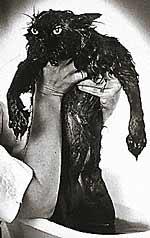
— Use the element of surprise. Pick up your cat nonchalantly, as if to simply carry him to his supper dish. (Cats will not usually notice your strange attire. They have little or no interest in fashion as a rule. If he does notice your garb, calmly explain that you are taking part in a product-testing experiment for J.C. Penney.)
— Once you are inside the bathroom, speed is essential to survival. In a single liquid motion, shut the bathroom door, step into the tub enclosure, slide the glass door shut, dip the cat in the water and squirt him with shampoo. You have begun one of the wildest 45 seconds of your life.
— Cats have no handles. Add the fact that he now has soapy fur, and the problem is radically compounded. Do not expect to hold on to him for more that two or three seconds at a time. When you have him, however, you must remember to give him another squirt of shampoo and rub like crazy. He’ll then spring free and fall back into the water, thereby rinsing himself off. (The national record is – for cats – three latherings, so don’t expect too much.)
— Next, the cat must be dried. Novice cat bathers always assume this part will be the most difficult, for humans generally are worn out at this point and the cat is just getting really determined. In fact, the drying is simple compared to what you
have just been through. That’s because by now the cat is semi-permanently affixed to your right leg. You simply pop the drain plug with your foot, reach for your towel and wait. (Occasionally, however, the cat will end up clinging to the top of your army helmet. If this happens, the best thing you can do is to shake him loose and to encourage him toward your leg.)
After all the water is drained from the tub, it is a simple matter to just reach down and dry the cat.
In a few days the cat will relax enough to be removed from your leg. He will usually have nothing to say for about three weeks and will spend a lot of time sitting with his back to you. He might even become psychoceramic and develop the fixed stare of a plaster figurine.
You will be tempted to assume he is angry. This isn’t usually the case. As a rule he is simply plotting ways to get through your defenses and injure you for life the next time you decide to give him a bath.
But, at least now he smells a lot better.

 Do It And How