-
Simple Book Press
-
 Flowers can be left between the pages of a heavy book. While this distributes enough weight and can hold many blooms, it is not the ideal way to preserve flowers. Older flowers can fall out of the pages as you open the book to add new ones. If you do not line the pages with additional paper, the blossoms could stick to the pages, leaving behind stains and even tearing the flowers as you take them out.
If you choose to press flowers in a book, do so only as a temporary method. Place the flowers between pages and mark those pages with a slip of paper. Do not press down to flatten the blossoms, as this will encourage sticking, but simply close the book over the blooms. Transfer within a few days to a more sturdy press.
Cardboard Press
-
A simple press can be made using cardboard, lining paper and rubber bands.
Good material for lining paper includes parchment paper or waxed paper, as the flowers are less likely to stick to the surface of the pages. Plain paper or brown butcher paper can be used, but the blossoms are more likely to stick. Newspaper is not advisable, as the ink could come off and discolor the blooms.
To form a cardboard press, place the flowers between squares of lining paper and sandwich the lining paper between squares of cardboard. You can repeat this layering as many times as necessary for as many flowers as you need to press. Always place the flowers between the lining paper, to prevent sticking, and the lining paper between cardboard, to add structure and weight. Secure the press with large rubber bands, arranging the bands evenly across the cardboard for even weight distribution.
-
Plywood Press
-
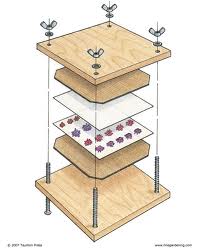 A plywood press uses the same structure of layering lining papers and cardboard, but adds an outer plywood shell. The top and bottom squares of plywood need holes drilled into all four corners to place bolts or screws. Wing nuts hold the bolts in place. The finished press looks like a miniature table, with a plywood top and bottom and bolts as legs.
This plywood press requires more effort than the cardboard press, but its construction produces more even weight distribution and a sturdier press.
-

- Comment
- Reblog
-
Subscribe
Subscribed
Already have a WordPress.com account? Log in now.
 Do It And How