
Category: Recycle it
Household Uses for Tennis Balls
1. Erase scuff marks. With a utility knife, cut an X in a tennis ball and slip it over the end of an old broom handle. Rub the ball over scuff marks on your wood floors; they’ll come right off.
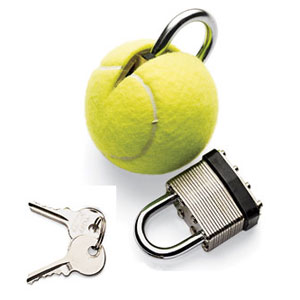 2. Protect a padlock. Cut a slit in a tennis ball with a utility knife and slip it over an outdoor padlock to prevent water from getting into it and freezing.
3. Remove a broken lightbulb. The bulb broke off in the socket? No problem. Carefully clear away any shards of broken glass, then gently push a tennis ball against the light socket and twist it to remove the bulb’s embedded stem.
4. Cushion the blow. Cut an X in a tennis ball and slip it over the head of a hammer so you don’t ding up walls, wood, or other fragile materials while you’re pounding away.
5. Install a parking guide. Hang a tennis ball from a string from the ceiling of your garage so that the ball touches the top left corner of the windshield when your car is properly parked. Now you’ll know how far to pull in each time you come home.
6. Open a jar. Cut a tennis ball in half. Use the open end to grip and unscrew tight lids.
7. Make a hitch cover. Make a long slit in a tennis ball with a utility knife. Slide the ball over the hitch of your trailer to keep it from scratching other cars (and protect it from getting damaged).
8. Collect change for tolls. Cut a slit in a tennis ball and stash spare change inside. Keep the ball in your car so you don’t have to grope for your wallet when you’re at the tollbooth.
9. Keep a door open. Who needs a doorstop? Wedge a tennis ball between the door and the doorjamb instead.
10. Get a better grip. Hold a tennis ball in each hand. Squeeze and release repeatedly to strengthen your hands and arms for using tools. VIA
Undent a Ping Pong Ball
 Drop your ball into the water. Watch it very carefully. As soon as it returns to its shape, scoop it out of the water. Put it in a paper towel and dry it. via
Magazine Art Vase
This project is similar to the Magazine Art Bowl featured earlier, but doesn’t use a balloon for the support.
Awesome!
Glass Etching
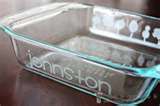
Make sure you wear latex gloves when working with etching cream; a long sleeve shirt and eye protection are also a good idea. Make sure the area you are working in is well-ventilated and the work surface is covered. The etching cream is an acid and it will etch anything it comes in contact with.
Clean your glass using window cleaner. Make sure it is dry and free of all dust and lint.
If you do not have a premade stencil: Cut a piece of contact paper at least a few inches larger than your pattern.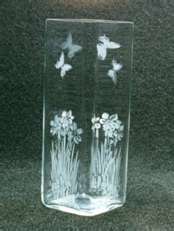
Place the contact paper on your glass where you want the etching to be; smooth out all air bubbles.
Place the carbon paper over the contact paper and then place the pattern over the carbon paper (secure these with a few, small pieces of masking tape if you like).
Trace your pattern onto the contact paper. Once done, remove the pattern and carbon paper.
Using a sharp utility knife cut all the details out of the contact paper. Remove pieces of the contact paper so only the sections of the glass that you want etched are exposed.
Make sure that all of the edges of the remaining pieces of contact paper are stuck tightly to the glass.
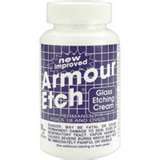 Put on the latex gloves. Use a foam brush to spread a thick layer of etching cream onto the exposed sections of your design (you can also use a paper towel). Be generous with the etching cream; if it is applied to thinly, your pattern could look uneven or streaked!
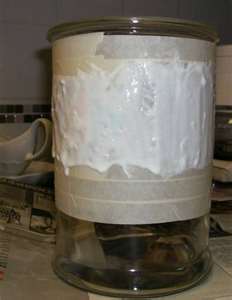 Set your glass in a safe spot and wait the amount of time required for the brand of etching cream you are using (this can vary, usually from 5 to 15 minutes).
After the prescribed amount of time, remove the etching cream usually by running water over it. Again, read the specific instructions for the brand of etching cream you purchased.
Once the cream is washed off you can remove the contact paper to reveal your design. Wash your glass and you are done!
Instructions via
 Do It And How