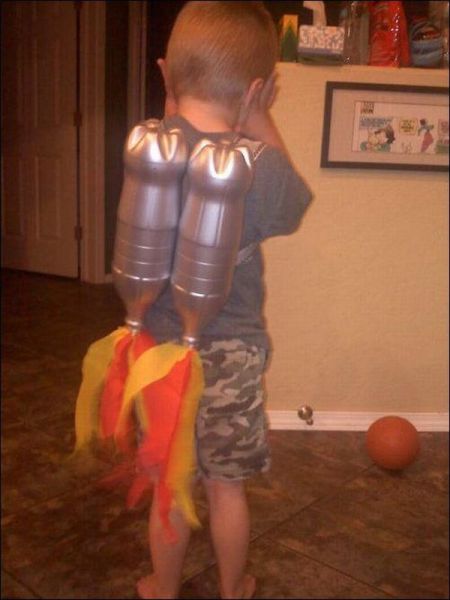
 Supplies:
- 2 empty plastic bottles
- silver strapping, such as elastic or ribbon
- flame colored (red, yellow & orange) tissue paper or crepe paper
- Silver duct tape
- Silver Spray paint
Directions:
Spray paint the bottles. Whey dry secure them together. Secure the strapping to fit the child over the shoulders and under the arms. Add paper flames out bottoms of bottles.
This is SO cute!!! via
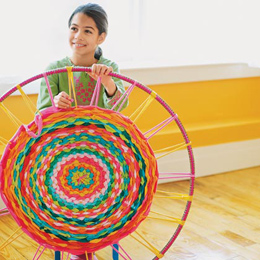
 For the warp, cut 1-inch-wide loops from the bodies of one or two tees (we found a boy’s large worked best on our 33-inch hoop), removing the hem and stopping at the sleeves. Ideally these loops should all be the same color; we used two colors for clarity in our photographs. You’ll need a total of 11 loops. For the weft, cut at least 50 loops from the remaining shirts. Save the unused sleeves for the basket project.
 Stretch one warp loop over the hula hoop, as shown.
 Add and secure a second loop, perpendicular to the first.
 Repeat, filling in the spaces, until all 11 loops are in place.
 Push together two warp loops at the top of the hula hoop, as shown. This creates an odd number of warp spokes in your wheel, which allows the overunder pattern of the weft to alternate with each new row.
 Secure the first weft loop to the center of one of the warp spokes (we chose the doubled spoke from step 5) by wrapping it around the warp and then looping it back through itself.
 Begin weaving the weft over and under the warp spokes, forming a tight spiral. For now, treat both parts of each warp spoke as a single unit, weaving over or under the two together. As you work, push the weft material toward the center of the hoop and keep it just snug. If you pull the weft tight, the rug will develop lumps or bends. When you reach the end of the piece of weft, add a new loop by threading it through the end of the first and back through itself.
 When your rug is about 8 inches across, begin treating each warp spoke as two individual strips instead of a single unit, weaving over or under each strand instead of going over or under the doubled spoke. This increases the number of warp spokes, improving the structure of the project. When you get to the two warp spokes that you pushed together at the top of the loom, separate them. Treat one of the spokes as two individual strips, but continue to treat the other as a single spoke. This maintains the odd number of warp spokes.
 When the rug is the size you want, but no closer than 8 inches from the edge of the hula hoop, snip open your weft loop.
 Tie the ends around a warp spoke, and tuck the ends into the rug.
 Tie the ends in pairs, then trim them to make a fringe or tuck them back into the rug.


 Do It And How